Water Treatment & Testing
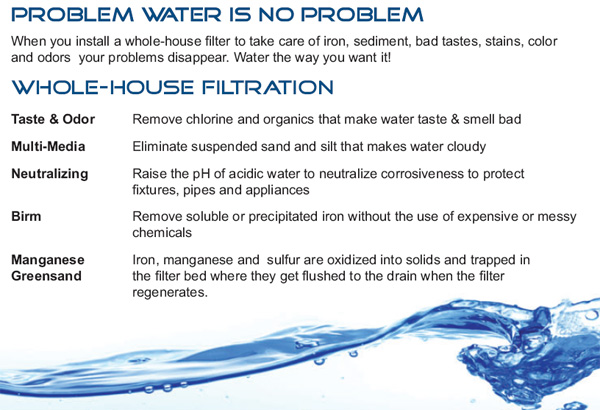
Fisher's Supply specializes in water softeners, iron removal systems, carbon media filters, sediment filters, sand separators, ozone filters, UV Lights, PH Filters, injection pumps, ice filters, and complete water quality systems with full installation services.
Complete water quality systems
Fisher's Supply specializes in water softeners, iron removal systems, carbon media filters, sediment filters, sand separators, ozone filters, UV Lights, PH Filters, injection pumps, ice filters, and complete water quality systems with full installation services.
Water softenersIron removal systems Carbon media filtersSediment filters Sand separatorsOzone filters UV LightsPH Filters Injection pumpsIce filtersHow to bring in a water sample
For iron, hardness, PH, or TDS testing please bring in a plastic bottle of your water for us to test here at the store.
- 1. Use a plastic bottleBring in a plastic bottle of your water for us to test here at the store.
- 2. Label it in permanent markerTo insure you get your results please write in permanent marker your name, address, phone number, and what we are testing for on your container.
- 3. Drop it at the counter659 SW 1st Ave, Canby, OR 97013. Mon–Fri 7:00–5:00, Sat 8:00–4:00, closed Sunday.
- Tested here at the storeIron, hardness, PH, or TDS.
- Checking a softenerBring us a sample from before and after the softener and we will compare the hardness levels.
Potability and nitrate testing
For potability and nitrate testing please come in or call for instructions on how to take the test and the schedule of pickup days, as these tests must go to the lab. You will also need to pick up a sterile lab test bottle from us. Instructions for the lab test procedure can also be downloaded from our resources page.
For water treatment questions or scheduling please contact Clinton at clinton@fisherssupply.com.
What hard water does
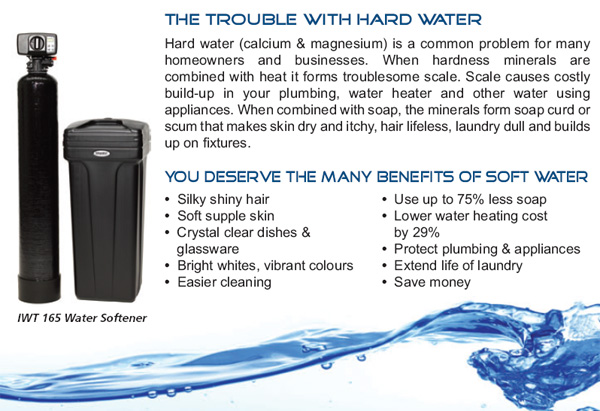
We call water "hard" if it contains a lot of calcium or magnesium dissolved in it. Hard water causes two problems:
- ScaleIt can cause "scale" to form on the inside of pipes, water heaters, tea kettles and so on. The calcium and magnesium precipitate out of the water and stick to things. The scale doesn't conduct heat well and it also reduces the flow through pipes. Eventually, pipes can become completely clogged.
- Soap scumIt reacts with soap to form a sticky scum, and also reduces the soap's ability to lather. Since most of us like to wash with soap, hard water makes a bath or shower less productive.
Conditioning and softening water is a 4 step process
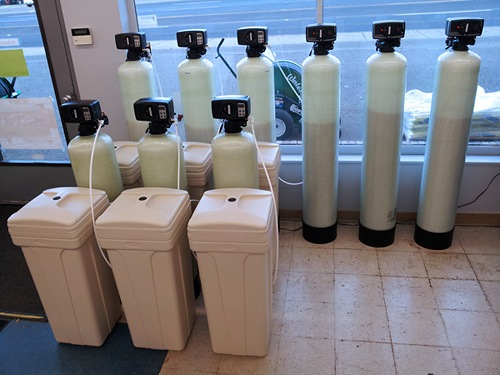
- 1. Resin beadsThe body of a water conditioner is a tank filled with resin beads. These beads are covered with sodium ions. As hard water passes through, the resin beads act like a magnet, attracting the calcium ions (hardness) in exchange for the sodium ions.
- 2. RegenerationEventually the resin beads become saturated with mineral ions and have to be "re-charged". This process is called regeneration, and is conducted by the control valve on the top of the tank. The control valve is the brain of the system.
- 3. BrineDuring regeneration, a strong brine (salt) solution is flushed through the resin tank, bathing the beads in a stream of sodium ions which replace the accumulated calcium and magnesium ions (hardness).
- 4. Flush to drainThe brine (salt) solution, carrying the displaced calcium and magnesium ions, is then flushed down the drain by fresh water. The regenerated (re-charged) resin beads can be used again and again.
Common water softener questions
How much salt does a softener put into water?
A softener only uses salt for the brine solution used to clean the media inside the tank. Once backwashed the salt solution is flushed out the drain line and this typically takes place in the middle of the night when water usage is at a minimum. It generally does not enter your household water supply unless something is not functioning correctly. On average, a softener will add about 35 milligrams of sodium per 8 ounce glass of water, a tablespoon of catsup has 204 milligrams of sodium. If you are able to taste salt in your tap water something is not correct and should be fixed to eliminate the problem.
Will a softener remove iron from water?
A softener can remove some iron if levels are low enough but are generally not used for iron removal. To properly remove iron an iron filter, which is similar to a softener, should be used. High levels of iron can clog up a standard softener and greatly shorten the lifespan of the media.
How can I make sure my softener is working properly?
To test the effectiveness of a softener it is best to test the water prior to the softener and after the softener and compare the hardness levels. This is a simple test we can do for you in the store if you bring us a sample from before and after the softener. The simplest test to insure proper function is to gauge salt usage. If your softener is not using salt on a regular basis something is not functioning properly and needs to be inspected.
Why is my softener regenerating during the day?
More than likely the time is not set correctly on the softener. The control valve is basically a clock that controls when it regenerates. If there has been any form of power outage the clock may not be correct and needs to be adjusted.
Removing iron
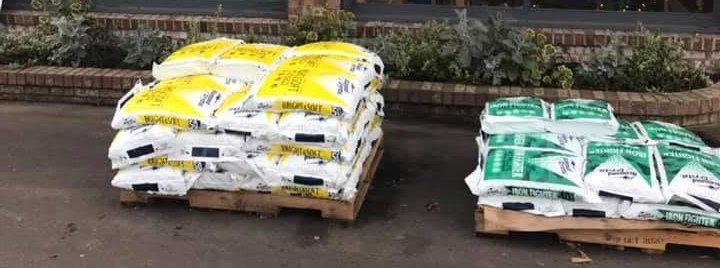
Iron is a natural occurring substance in the earth. When your well water comes into contact with iron deposits, they dissolve and are carried along with the water into your home. Iron stains many things that it comes into contact with in and around your home. This includes all appliances (washing machines, dishwashers, ice makers, coffee makers, etc.) as well as plumbing fixtures, clothes and fabrics. The amount of iron in your water is measured in parts per million (ppm). Levels of 0.3 ppm and greater will cause staining.
An iron filter is very similar to a water softener in appearance and how it operates. The most obvious difference is the lack of a brine tank as iron filters do not use salt. Internally an iron filter contains different media than a softener.
Removing bacteria
UV lights are used to kill bacteria and other micro-organisms found in water. UV sterilization kills 99.99% of harmful microorganisms, including E. coli, Cryptosporidium and Giardia.
UV lights have a lifespan of one year and should be replaced every year. Even if the light appears to still be working, the bulb and quartz sleeve needs to be replaced as the spectrum of light and intensity of UV rays is depleted in a year.
What reverse osmosis does and does not do
Reverse osmosis is a valuable water purification process when mineral-free water is the desired end product. Most mineral constituents of water are physically larger than water molecules. Thus, they are trapped by the semi-permeable membrane and removed from drinking water when filtered through a reverse osmosis system. Such minerals include salt, lead, manganese, iron, and calcium.
Although reverse osmosis does extract several contaminants from drinking water, its removal capabilities are not ideally suited to the challenges of the municipally treated water that the overwhelming majority of people receive. Municipal water contains such contaminants as chlorine and volatile organic chemicals (VOCs). Because these contaminants are physically smaller in size than water, the semi-permeable membrane cannot prohibit them from passing through with the water. Thus, they remain in drinking water.
Reverse osmosis, also, by removing alkaline mineral constituents of water, produces acidic water. Trace elements of minerals were intended to be in water; their removal leaves tasteless, unhealthy drinking water. Reverse osmosis, although it is less wasteful than distillation, is still an incredibly inefficient process. On average, the reverse osmosis process wastes three gallons of water for every one gallon of purified water it produces.
Bring us a sample
Iron, hardness, PH, or TDS we test here at the store. For water treatment questions or scheduling contact Clinton at clinton@fisherssupply.com.